Spring Fence Installation in Magic Valley: Material Costs & Comparison 2026

TL;DR — Key Takeaways
- Late May to June is the best window for fence installation in Twin Falls. April rain leaves soil too soft and unstable for solid post setting.
- Wood is the most affordable upfront ($20 to $50/linear ft installed) but carries the highest long-term cost due to Idaho's freeze-thaw cycles and required maintenance every 2 to 3 years.
- Vinyl ($30 to $60/linear ft) offers strong durability with minimal maintenance and performs well in Idaho's climate, provided you invest in quality, UV-stabilized material.
- Composite ($28+/linear ft for materials) costs the most upfront but typically delivers the lowest total cost of ownership over 20 years and handles Idaho's seasonal extremes the best.
- Twin Falls County requires fence posts to be set at least 24 inches deep per official frost line code. Proper post depth is what separates a fence that lasts from one that heaves and fails within a few years.
Why Spring Timing Matters in Idaho
Spring feels like the obvious time to start outdoor projects, but not all of spring is created equal, especially in the Magic Valley. The key factor is soil condition, and Idaho's freeze-thaw cycles make this more consequential than most homeowners expect.
When the ground repeatedly freezes and thaws, it disrupts soil structure and hydraulic properties. In practical terms for fence installation, this means early spring soil, particularly in April, can be waterlogged and unstable. Concrete footings poured into saturated ground don't cure correctly, and posts set in soft soil are more prone to shifting as conditions change.
The best installation window for Twin Falls is late May through June. By this point the ground has firmed back up after spring moisture, temperatures are stable for concrete curing, and you're ahead of the peak summer backlog. Booking in April for a late May or June start is the smart move.
There's also an elevation factor worth knowing. Twin Falls sits at approximately 3,700 feet above sea level. Higher elevation means UV radiation is noticeably more intense than at sea level, a detail that directly affects how quickly untreated wood degrades and which vinyl and composite products will hold their color over time.
From a scheduling standpoint, spring and summer are peak season for fence contractors across the Magic Valley. Lead times of 2 to 3 weeks are common once warm weather arrives. If your timeline is flexible, fall installations (September through October) can yield 5 to 10% savings as contractor demand eases, but you'll miss the full summer season in your new fence.
What to Evaluate Before Choosing a Material
Most homeowners compare fences on upfront price alone. That's the single biggest mistake you can make. A fence is a 15 to 30 year asset, and the installation price tag is often the smallest part of what you'll actually spend. Here are the four factors that should drive your decision:
Upfront installation cost: what you pay on day one, including materials and labor. Labor alone typically accounts for 40 to 50% of total fence costs nationally, according to Angi's survey of over 10,000 homeowners.
Lifespan: how long the fence realistically lasts with normal care in your specific climate. A fence rated for 20 years in Florida may perform very differently in Idaho's freeze-thaw environment.
Maintenance cost over time: staining, sealing, board replacement, repairs. This is where wood fences consistently surprise homeowners. The upfront savings can disappear quickly once recurring maintenance costs are factored in over a decade.
Idaho climate performance: Twin Falls experiences cold winters, hot dry summers, significant UV at elevation, and freeze-thaw cycles that are hard on any structure set in the ground. Not every material handles this equally.
Wood Fence: The Classic Choice
Installed cost: $20 to $50 per linear foot
Wood is the most affordable entry point, and it offers something no manufactured material can fully replicate: a genuinely natural look that you can paint or stain any color. According to Angi's cost data, the average wood fence installation runs around $3,238, with most homeowners paying between $1,919 and $4,844 depending on wood species, fence height, and yard conditions.
Lifespan by Wood Type
Not all wood is equal in Idaho's climate. Cedar contains natural oils that resist decay and insects, giving it a realistic lifespan of 15 to 30 years with proper care. Pressure-treated pine is the budget option at 10 to 20 years but requires more frequent attention. Redwood sits at the premium end, naturally resistant and capable of lasting 20+ years, but it's harder to source in the Magic Valley and comes at a higher price.
The Real Cost: Maintenance
This is where the wood calculation changes significantly. A wood fence requires staining or sealing every 2 to 3 years to stay healthy in Idaho's climate. According to Frame It All's 30-year cost analysis, staining and sealing a 150-foot fence runs $300 to $700 per application, and that's before accounting for board replacements, post treatments, and hardware. Their conservative estimate puts the 10-year maintenance total for a wood fence at $4,000 to $8,500.
In Idaho specifically, the freeze-thaw cycle is wood's biggest enemy. When moisture gets into small cracks in wood and freezes, it expands and widens those cracks, a cumulative process that accelerates aging year over year. At Twin Falls' elevation, UV intensity also breaks down untreated wood surfaces faster than most homeowners expect.
On the frost line: Twin Falls County's official frost line depth is 24 inches below finished grade. Wood posts set shallower than this are at risk of frost heave, where expanding frozen soil pushes posts upward and sideways, causing fence sections to lean or fail within a few years. This applies to all fence materials, but wood posts are also vulnerable to rot at ground level if drainage isn't properly addressed at installation.
Best for: Homeowners who want the lowest upfront cost, full color customization, and are genuinely committed to maintenance every 2 to 3 years.
Not ideal for: Homeowners who want low-maintenance ownership or plan to stay long-term without ongoing upkeep investment.
Vinyl Fence: The Low-Maintenance Middle Ground
Installed cost: $30 to $60 per linear foot
Vinyl sits in the middle of the market on price but toward the top on convenience. It doesn't rot, doesn't attract insects, and doesn't need painting or staining. According to NerdWallet, most homeowners spend $2,000 to $5,000 for a professionally installed vinyl fence, with labor rates ranging $25 to $80 per hour depending on complexity.
Lifespan and Weather Performance
A properly installed vinyl fence typically lasts 20 to 30 years. The key word is "properly." Quality matters significantly. Premium vinyl uses titanium dioxide (TiO2) as a UV stabilizer baked into the material itself, not just surface-coated. This is what prevents the yellowing, brittleness, and fading that lower-grade vinyl develops within 10 years, especially at Idaho's elevation where UV exposure is more intense.
In cold temperatures, vinyl's behavior is worth understanding. High-quality vinyl is engineered with flexibility that allows it to handle freeze-thaw cycles without cracking. Lower-grade products become brittle in extreme cold. If you're investing in vinyl for an Idaho property, ask the installer about wall thickness, UV inhibitor content, and what the warranty actually covers in temperature extremes.
Maintenance Reality
Vinyl's maintenance needs are minimal: an occasional rinse with soap and water is typically all that's required. No staining schedule, no sealing, no board replacement from rot. For homeowners who want a fence that simply works without recurring weekend maintenance projects, vinyl delivers on that promise, provided the initial product and installation quality are right.
One honest trade-off: vinyl offers limited style options compared to wood, mostly white, tan, and wood-grain patterns. And if a panel is damaged by impact, repair often means replacing the full panel rather than patching a single board. Worth considering if you have heavy equipment operating near the fence line.
Best for: Homeowners who want durable, low-maintenance performance without ongoing upkeep costs.
Not ideal for: Those who want extensive color customization or are working with a tight upfront budget.
Composite Fence: The Long-Game Investment
Materials: $28+ per linear foot
Composite fencing, made from a blend of recycled wood fibers and plastic polymers known as WPC (wood-plastic composite), sits at the premium end of the residential fencing market. It's engineered to look like natural wood while resisting the things that destroy it: rot, insects, moisture, and UV degradation.
Lifespan and Total Cost of Ownership
Composite fencing typically lasts 25 to 30 years, with premium products backed by 25-year manufacturer warranties. That's meaningfully longer than the average wood fence (10 to 20 years) and comparable to or exceeding vinyl in real-world Idaho conditions.
The more compelling number is lifecycle cost. Frame It All's 30-year cost comparison found that composite typically reaches its break-even point against wood within 8 to 12 years, before wood even hits its first major structural repair. By year 20, the cumulative cost advantage of composite can exceed $15,000 for a mid-sized fence perimeter, once you factor in avoided staining, sealing, board replacement, and repair costs.
Idaho Climate Performance
Composite handles Idaho's seasonal extremes better than both wood and vinyl. Its dense construction resists the freeze-thaw cracking that shortens wood's life, and it doesn't become brittle in cold the way lower-grade vinyl can. Because it doesn't absorb moisture, it also eliminates the rot-at-post-base problem that's one of the most common causes of early fence failure in the Magic Valley.
Environmental Angle
Composite is manufactured from recycled materials, typically recycled plastic and reclaimed wood fibers, reducing demand for virgin timber and diverting waste from landfills. For homeowners for whom sustainability is a factor, this is worth considering alongside the performance data.
One honest trade-off: darker composite colors are more susceptible to visible fading from UV exposure over time. In Twin Falls, where UV intensity is higher at elevation, lighter composite colors (white, light gray, tan) hold their appearance better over the long run. If you want a dark brown or black composite, factor in that the color may noticeably soften within 10 to 15 years.
Best for: Homeowners planning to stay long-term who want the natural look of wood without the maintenance burden and who want the lowest total cost of ownership over 20+ years.
Not ideal for: Tight upfront budgets, or if you want very dark fence colors and prefer they stay vivid indefinitely.
Side-by-Side Comparison
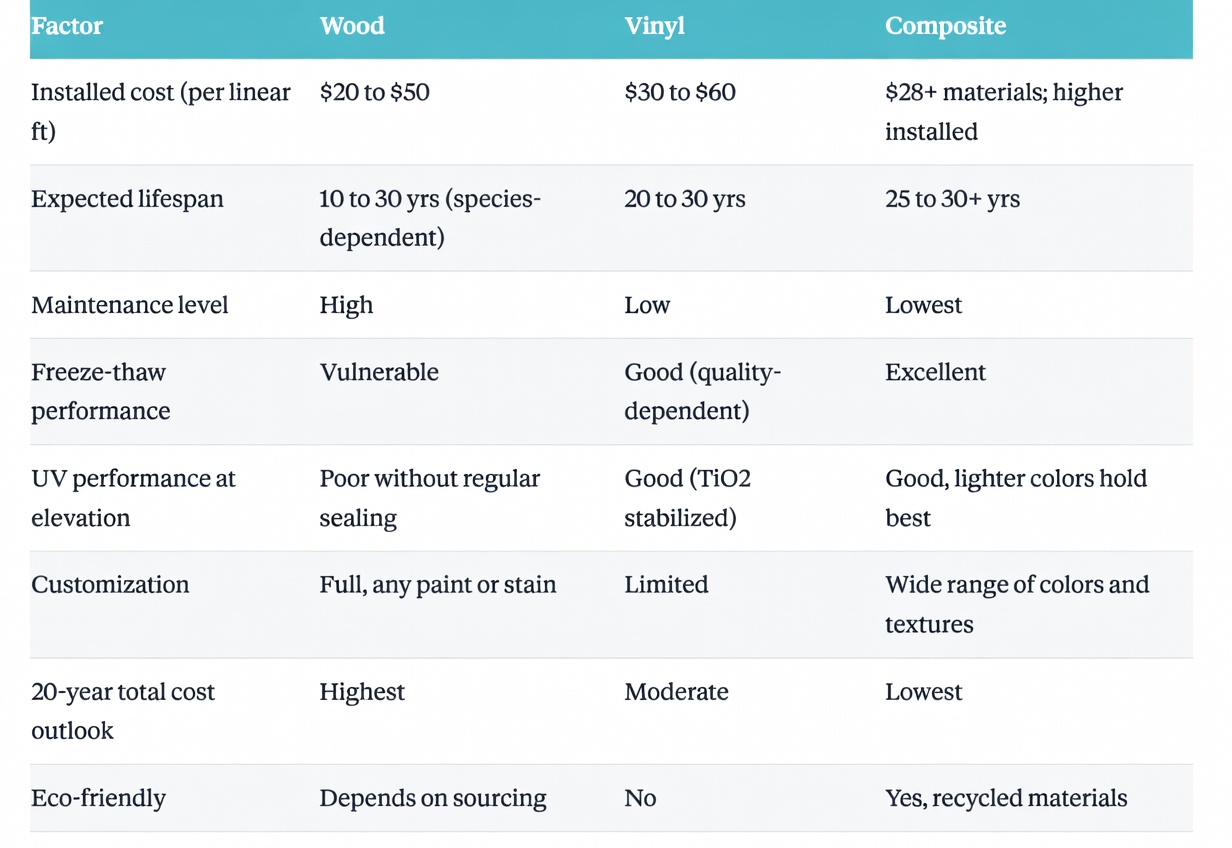 |
What Does a Fence Actually Add to Your Home's Value?
Fencing ROI is one of the most overstated topics in home improvement content. Here's what the data actually says, including the less flattering numbers most fencing companies won't share.
According to Angi's analysis, the average ROI for fence installation is approximately 50%, translating to roughly $950 to $2,400 in resale value on a typical fence project. Homeowners can realistically expect to recoup between 30 to 70% of installation costs at resale, depending heavily on material quality, condition, and local market.
From an appraiser's perspective, the honest number sits on the lower end of that range. KW Appraisal Group, drawing on nearly 20 years and approximately 8,000 homes of appraisal experience, puts the realistic ROI at 30 to 40% of upfront investment from a pure dollar-for-dollar standpoint. Where fences add outsized value is in buyer appeal. Properties with fenced yards attract a broader pool of buyers, particularly families with children or pets, and often sell faster as a result.
The National Association of Realtors' 2024 data indicates a fence can boost resale value by up to 7% when it improves the overall aesthetic appeal of the property and fits the neighborhood context. The key phrase is "fits the context." A fence that looks out of place, or is in poor condition, can actually work against you at resale.
The practical takeaway: Don't install a fence primarily as a financial investment. Install it because you'll use and enjoy it: the privacy, the safety for kids and pets, the curb appeal. The resale benefit is real but secondary. The material you choose, and how well it's maintained, determines whether it helps or hurts your home's value when the time comes to sell.
Permits and Local Codes in Twin Falls
This is the section most homeowners skip, and it's genuinely important.
Permit Requirements
Twin Falls and most surrounding Magic Valley municipalities require a building permit for fence installation. Permits ensure compliance with setback rules, height restrictions, and HOA guidelines where applicable. Permit fees typically run $50 to $200 depending on the municipality and project scope. Installing without a permit creates problems at resale. Unpermitted structures can require removal or retroactive approval when a property sale triggers inspection.
The Frost Line Rule
Twin Falls County's official building code sets the frost line depth at 24 inches below finished grade. This is the minimum depth fence posts must reach to sit below the zone where soil freezes in winter.
When soil freezes, it expands. Water in soil increases in volume by approximately 9% as it freezes, generating significant upward and lateral pressure against anything embedded in the ground. Posts set above the frost line experience this force directly, causing them to shift, heave, and eventually destabilize the fence. Experienced local installers typically go 30 to 36 inches deep, beyond the code minimum, to provide an additional margin of stability, particularly for taller fences or in high clay-content soil, which is common in parts of the Magic Valley.
A Note on Post Drainage
Alongside post depth, drainage at the post base matters for long-term performance. Six inches of 3/4-inch gravel at the bottom of each post hole allows water to drain away from the post rather than pooling and freezing against it. It's a small addition to installation time and cost that significantly extends wood post lifespan.
HOA Considerations
If your property falls under an HOA, review your CC&Rs before choosing a material or style. Many HOAs in Twin Falls and surrounding communities restrict fence height, material type, and color, particularly in front yards. Getting approval before installation avoids costly changes after the fact.
Frequently Asked Questions
What's the best time in spring to install a fence in Twin Falls?
Late May through June is the best window. April's frequent rain leaves soil waterlogged and unstable. Concrete footings don't cure correctly in saturated ground, and posts set in soft soil shift as conditions change. By late May the ground has firmed up and temperatures are stable for curing. If you're planning a spring installation, book your contractor early in the season to secure your preferred dates before summer backlog sets in.
Do I really need a professional installer, or can I DIY this?
Vinyl panels are prefabricated and relatively DIY-friendly compared to wood or composite. That said, all three materials require correct post depth, concrete work, level alignment, and local code compliance, and errors in any of these compound over time. Post depth in particular is difficult to verify or correct after installation. If posts heave within 3 to 5 years due to incorrect depth, the repair cost typically exceeds what professional installation would have cost in the first place.
How long does installation take?
Vinyl is the fastest. Most residential vinyl projects finish in a single day. Wood and composite typically take 2 to 5 days depending on total length and site complexity. Factor in 1 to 2 additional days for concrete footings to fully cure before the fence takes any lateral load.
Which material has the best return on investment?
It depends on what kind of ROI you mean. For total cost of ownership over 20 years, composite wins once you factor in avoided maintenance costs. For upfront cost recovery at resale, all three materials perform similarly. Installation quality and condition matter more than material choice alone. For homeowners planning to sell within 5 to 7 years, vinyl offers a strong balance of durability and buyer appeal without composite's higher upfront cost.
How does Idaho's climate specifically affect each material?
Wood is the most affected. Freeze-thaw cycles crack and warp boards, and UV at elevation accelerates surface degradation without consistent sealing. Vinyl handles Idaho well provided you choose quality material with proper UV stabilizers. Lower-grade vinyl becomes brittle in extreme cold. Composite is the most climate-resilient option. Its moisture-resistant construction handles both freeze-thaw cycles and high-elevation UV better than the alternatives.
What permits do I need, and how long does approval take?
Most Twin Falls and Magic Valley municipalities require a building permit for fence installation. Approval timelines for straightforward residential permits typically run a few business days to a couple of weeks depending on the municipality and current workload. A good contractor will handle the permit application and factor the timeline into your project schedule.
Have questions about your fence project in Twin Falls or the Magic Valley? Scout Construction offers free estimates and straight answers from a licensed local contractor who knows Idaho conditions. Call us at (208) 613-9830 or get in touch here.
Contact Scout Construction LLC
📍2414 Addison Ave E, Twin Falls, ID
Licensed & Insured | Contractor License No. 9861172
Mon-Fri 9AM-6PM
Serving the Magic Valley
Scout Construction provides professional home remodeling services in Twin Falls, Jerome, Kimberly, Filer, Buhl, Burley, and throughout the Magic Valley region. Contact us for a free estimate.