Hardwood vs. Tile for Twin Falls Basements: Choose Smart

TL;DR — Key Takeaways
- Twin Falls basements face a moisture challenge that most homeowners underestimate. Seasonal humidity swings from 77% in winter down to 28% in summer, combined with spring snowmelt pushing hydrostatic pressure through concrete slabs, make flooring material choice critical.
- Solid hardwood is not recommended for basement installation in Idaho. The National Wood Flooring Association requires indoor humidity to stay between 35% and 55% for wood floors to perform correctly, a standard Twin Falls basements routinely cannot meet without significant mechanical intervention.
- Porcelain tile is the most moisture-resilient flooring option available for basements. Per ANSI A137.1, porcelain absorbs 0.5% water or less, classifying it as impervious. It will not warp, cup, or degrade from moisture under your slab.
- Luxury vinyl plank (LVP) is a strong middle-ground option for basements with normal moisture levels. It is 100% waterproof, significantly cheaper than tile, and mimics the look of hardwood without wood's vulnerability.
- No flooring material should go down over a concrete slab without moisture testing first. Every flooring manufacturer requires it, and skipping this step voids most warranties.
The Moisture Reality of Twin Falls Basements
Before you choose a floor, you need to understand what your basement is actually dealing with. Most homeowners think about moisture in terms of leaks: a visible puddle, a wet wall after a storm. But in the Magic Valley, the bigger threat is invisible.
Twin Falls has a semi-arid climate, but that description is misleading when it comes to basements. According to Weather Atlas' 30-year climate data for Twin Falls, outdoor relative humidity peaks at 77% in December and drops to 28% in July. That seasonal swing matters because basements are not sealed environments. Humidity moves in and out through concrete walls, floor slabs, and any gap in the building envelope, and concrete, despite feeling solid and dry, is porous.
The bigger seasonal threat is spring. The Western Regional Climate Center, a NOAA-affiliated research body, documents that Idaho's freeze-thaw cycles produce significant soil moisture movement each spring as snowmelt saturates the ground. When that saturated soil surrounds your foundation, it creates hydrostatic pressure, water pushing upward and inward against your basement floor slab. According to Idaho Concrete Lifting, volcanic and clay-heavy soils common in southern Idaho retain water and shift during freeze-thaw cycles, directly increasing moisture migration through concrete, which is exactly the type of soil found throughout the Twin Falls and Magic Valley region.
Here is what this means practically: even a basement that has never had a visible water event is actively managing moisture movement through its slab year-round. Building Science Corporation, one of the leading building science research institutions in North America, confirms that the relative humidity below every building slab approaches 100% regardless of water table depth or annual precipitation. Your slab is always in contact with moisture from below. The flooring material you choose needs to handle that reality, not just perform well when conditions are ideal.
Why Solid Hardwood Fails in Idaho Basements
Hardwood is a genuinely beautiful flooring material, and we install it in plenty of homes across the Magic Valley. But the basement is not the right place for it, and understanding why helps you make a better decision for your whole project.
Wood is hygroscopic. It absorbs and releases moisture to match its surrounding environment. The National Wood Flooring Association (NWFA), the industry's governing body on wood flooring standards, specifies that wood flooring performs correctly only when interior relative humidity stays between 35% and 55% and temperatures remain between 60°F and 80°F. Outside that range, the consequences are not cosmetic. They are structural.
When humidity rises above 55% in a basement environment, wood fibers absorb moisture and expand. Because the edges of a plank absorb moisture faster than the center, the edges push up higher than the middle of the board. This is called cupping, and the NWFA documents it as one of the most common and often irreversible forms of moisture damage in wood flooring. Once a board has cupped severely, sanding and refinishing typically cannot restore it to its original profile.
The problem compounds in a basement because moisture is not just coming from the air. It is also coming up through the slab. The NWFA's installation guidelines specify that for concrete slabs with a relative humidity reading greater than 75%, an impermeable vapor retarder must be installed before any wood flooring. Given that Building Science Corporation confirms slab relative humidity approaches 100% in most below-grade applications, meeting that threshold consistently in a Twin Falls basement would require aggressive and continuous mechanical dehumidification, a cost and maintenance burden most homeowners are not prepared for.
The honest bottom line on solid hardwood: it is not a basement material in Idaho's climate. Installing it below grade is not a risk you can manage with a dehumidifier alone. It is a timing question, not if it will fail, but when.
What About Engineered Hardwood?
Engineered hardwood is a reasonable question here, and it deserves a direct answer.
Unlike solid hardwood, engineered hardwood is constructed with multiple cross-ply layers of wood bonded under high pressure, with a solid hardwood veneer on top. That layered construction makes it significantly more dimensionally stable than solid wood. It resists the expansion and contraction caused by humidity fluctuations better than a single-piece plank. It can be installed over concrete, and some manufacturers offer waterproof-core engineered products designed specifically for below-grade applications.
So yes, engineered hardwood is a more viable option for basements than solid hardwood. But it is still not a set-it-and-forget-it solution in Twin Falls. Engineered hardwood is moisture-resistant, not moisture-proof. It still requires concrete moisture testing before installation, proper vapor barrier protocols, and humidity management. HomeAdvisor's flooring cost data puts engineered hardwood at $3 to $13 per square foot for materials, with installation adding further cost. If moisture conditions are not controlled, that investment is at risk.
If the wood look matters to you and you want a hardwood product in your basement, engineered hardwood with a thick wear layer and a moisture-tested, properly prepared slab is a workable path. But for most Twin Falls homeowners, the combination of Idaho's moisture conditions and the preparation required makes tile or LVP a more reliable and cost-effective choice for below-grade spaces.
Porcelain and Ceramic Tile: Why It Performs in Idaho Basements
Tile is the most moisture-resilient hard flooring option available for basements, and the reason is measurable and standardized, not just marketing language.
Per ANSI A137.1, the American National Standard for ceramic tile, porcelain tile is defined as having a water absorption rate of 0.5% or less when tested per ASTM C373. This is the "impervious" classification, the highest moisture resistance rating in the industry. For context, semi-vitreous ceramic tile absorbs 3% to 7% of its weight in water. Porcelain absorbs less than half a percent. That difference is material when your floor is sitting above a slab that Building Science Corporation confirms is managing near-100% relative humidity below it year-round.
What this means practically: porcelain tile will not cup, warp, buckle, or degrade from the moisture conditions present in a typical Twin Falls basement. It is dimensionally stable regardless of whether your basement runs at 40% relative humidity in July or 70% in February. A water event, spring snowmelt finding a crack in your foundation or a sump pump that briefly fails, will not destroy a properly installed tile floor. It will dry, and the floor will be fine.
What Tile Actually Costs
According to Angi's 2026 cost data, based on surveys of over 10,000 homeowners, the average ceramic tile installation costs $4,800, or $12 to $45 per square foot. Most projects fall between $1,300 and $7,500 depending on tile selection, room size, and subfloor condition. Homewyse's January 2026 data, cross-referenced with Bureau of Labor Statistics and HUD cost data, puts the baseline cost to install a tile floor at $16.38 to $20.21 per square foot.
Tile costs more upfront than LVP and is more labor-intensive to install than most other flooring types. That higher installation cost reflects a legitimate skill requirement. Tile needs to be cut precisely, set in thinset, grouted, and given adequate cure time. Rushing any part of that process creates problems that show up months later. Professional installation is not optional if you want a tile floor that performs for 25 to 50 years.
The One Real Maintenance Requirement
Grout lines are tile's vulnerability in high-humidity environments. Unsealed or deteriorating grout can allow moisture to migrate beneath the tile, leading to adhesive failure and eventually loose or cracked tiles. Grout in a basement application should be sealed at installation and resealed every 1 to 3 years depending on moisture exposure and foot traffic. This is a minor and inexpensive maintenance task, far less demanding than the annual staining and sealing schedule a wood floor requires.
Comfort on a Cold Slab
A common concern with tile in basements is that it feels cold underfoot, particularly over a concrete slab. This is a legitimate observation. The practical solutions are area rugs in high-traffic zones, radiant heating installed beneath the tile, or insulated underlayment. HomeAdvisor's data puts radiant floor heating installation at $1,770 to $5,900 per room, a meaningful addition for a bedroom or family room finish, and something worth factoring into your planning if comfort matters.
Luxury Vinyl Plank: The Practical Middle Ground
If you want the look of wood in your basement but want to avoid wood's moisture vulnerability, luxury vinyl plank is worth a serious look.
LVP is 100% waterproof. Unlike wood flooring that absorbs moisture from its environment, LVP's construction, typically a rigid stone plastic composite or wood plastic composite core with a printed wear layer, does not respond to humidity changes. It will not cup, warp, or buckle from the moisture conditions in a Twin Falls basement.
According to HomeAdvisor's LVP cost data, installation in a standard basement up to 1,000 square feet ranges from $3,000 to $18,000, with per-square-foot costs of $3 to $10 for materials plus $2.50 to $6 for labor. That makes LVP significantly more affordable than tile on most projects, and its click-lock installation system means it goes down faster with less labor intensity.
Wear layer thickness matters more than most homeowners realize when choosing LVP. A 6-mil wear layer is entry-level, appropriate for low-traffic areas, and typically lasts 5 to 10 years. A 12-mil wear layer is mid-range at 10 to 15 years, suitable for standard residential use. A 20-mil commercial-grade wear layer is the long-term investment, lasting 15 to 20 years even in high-traffic spaces. For a finished basement that will serve as a family room or play area, a 12-mil minimum is the practical recommendation.
One honest limitation: LVP is not the right choice if your basement has a history of standing water or serious flooding. For spaces with active moisture intrusion events rather than normal below-grade humidity, tile or epoxy coating remains the more appropriate choice. For typical Twin Falls basements with managed moisture levels, LVP is a reliable, attractive, and cost-effective option.
Side-by-Side Comparison
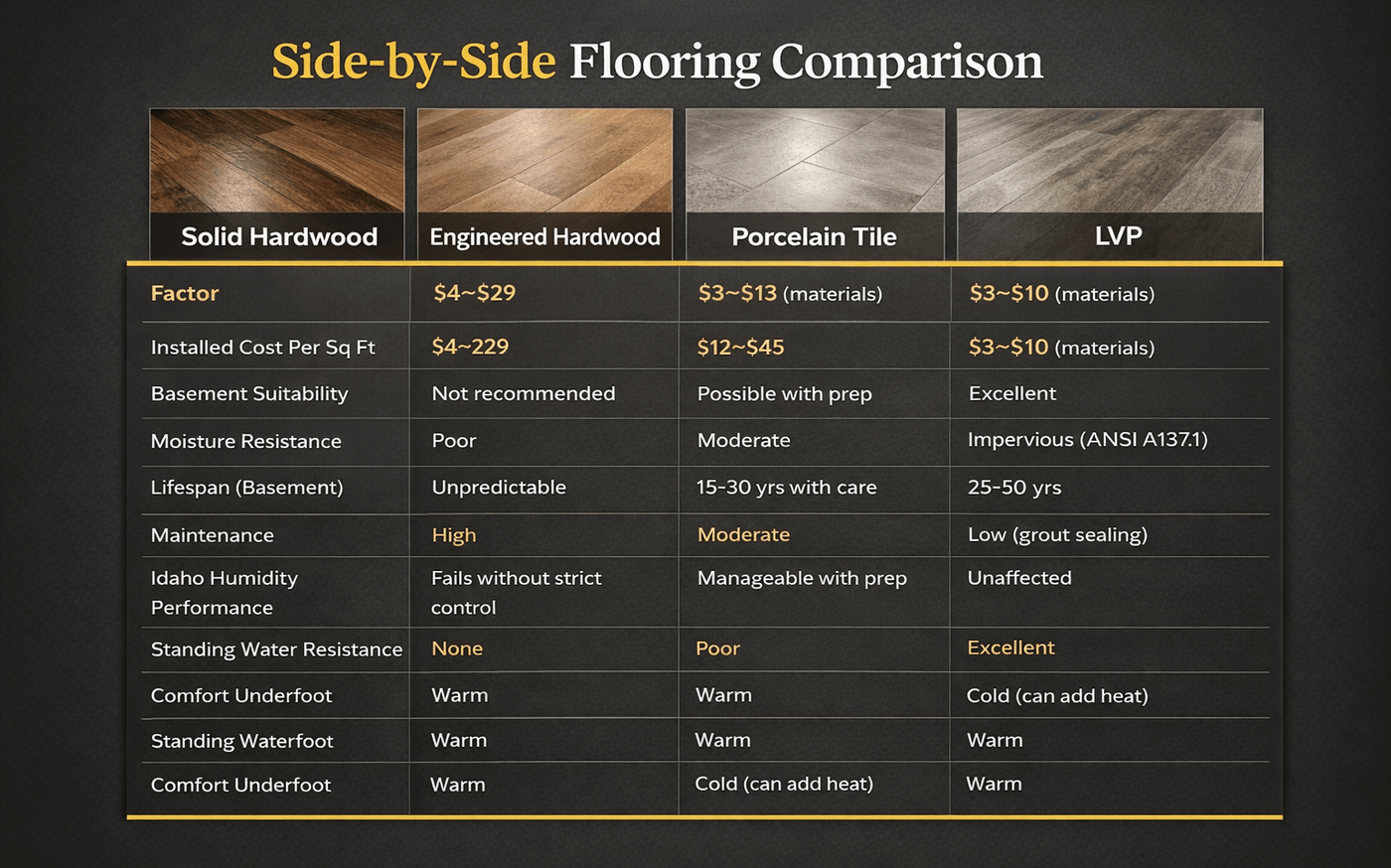 |
Cost data: Angi (2026, 10,000+ surveyed homeowners), HomeAdvisor (30,000+ surveyed homeowners), Homewyse (BLS + HUD data, January 2026).
One Step That Cannot Be Skipped: Concrete Moisture Testing
Regardless of which material you choose, the concrete slab must be tested for moisture before any flooring goes down. This is not a precaution. It is an industry requirement.
The NWFA mandates concrete moisture testing before any wood or engineered wood flooring installation, using ASTM F2170 in-situ relative humidity probes or ASTM F1869 calcium chloride tests as the recognized methods. Most flooring manufacturers, including tile and LVP manufacturers, require the same testing to honor their product warranties. According to concrete moisture testing specialists, most flooring warranties are void if slab moisture is not tested and documented prior to installation.
The test itself involves drilling small holes into the slab, inserting relative humidity probes, and reading the moisture level at 40% of the slab's depth after a minimum 24-hour equilibration period. This is the ASTM F2170 method, which gives the most accurate picture of moisture conditions within the slab rather than just at the surface. The American Concrete Institute recommends a vapor retarder be installed directly below any slab that will receive moisture-sensitive flooring, and for older Twin Falls homes where that sub-slab vapor barrier may not exist, surface-applied moisture mitigation or epoxy sealing may be needed before flooring can be safely installed.
This step adds a small amount of time and cost to a basement flooring project. It also prevents the much larger cost of pulling up and replacing flooring that failed because the slab conditions were not assessed first.
Frequently Asked Questions
Can I install solid hardwood in my Twin Falls basement if I run a dehumidifier?
A dehumidifier helps maintain ambient humidity in the basement air, but it does not address the moisture migrating upward through the concrete slab itself. The NWFA's concern with below-grade wood installation is not just about air humidity. It is about moisture vapor transmission from the slab making direct contact with wood flooring. A dehumidifier addresses one of those sources, not both. For most Twin Falls basements, this is not a risk we recommend taking with solid hardwood.
Is LVP or tile better for a basement bedroom?
For a basement bedroom where comfort underfoot matters, LVP is often the better choice. It is warmer underfoot than tile over a concrete slab, quieter, and significantly less expensive. Tile is the better choice if the bedroom is in a basement with a history of moisture events, or if your long-term plan is to maximize durability and not replace the floor for 30 to 40 years.
How much does it cost to finish a basement floor in Twin Falls?
For a typical 500 to 800 square foot basement, tile installation runs approximately $6,000 to $18,000 depending on tile selection and subfloor condition. LVP in the same space typically runs $1,500 to $8,000. Engineered hardwood with proper moisture prep falls between those ranges. These figures are consistent with Angi and HomeAdvisor's 2026 national cost data, adjusted for Idaho's regional labor market.
How often does tile grout need to be resealed in a basement?
Every 1 to 3 years depending on moisture exposure and foot traffic. It is a straightforward DIY task for most homeowners: apply a penetrating grout sealer with a brush or applicator and allow it to cure. The cost of sealer for a standard basement is typically under $30. This is the full extent of tile's ongoing maintenance requirement in a below-grade space.
What is the single most important thing to do before installing any basement flooring?
Test the concrete slab for moisture. It takes 24 to 48 hours and costs a fraction of what you would spend on flooring materials. It is required by virtually every flooring manufacturer to maintain product warranties, and it tells you whether you need additional moisture mitigation before any material goes down.
Thinking about finishing your basement in Twin Falls or the Magic Valley? Scout Construction handles basement finishing from subfloor prep and moisture assessment through final installation. We assess your specific moisture conditions first, recommend the right material for your space, and install it correctly so it lasts. Call us at (208) 613-9830 or get in touch here for a free estimate.
Contact Scout Construction LLC
📍2414 Addison Ave E, Twin Falls, ID
Licensed & Insured | Contractor License No. 9861172
Mon-Fri 9AM-6PM
Serving the Magic Valley
Scout Construction provides professional home remodeling services in Twin Falls, Jerome, Kimberly, Filer, Buhl, Burley, and throughout the Magic Valley region. Contact us for a free estimate.